A journey to search my soul

This is a blog of my personal collections. The purpose of this blog is to educate myself and public in regards to antiquities especially related to religion and calligraphy. I welcome everyone to input their feedback in this blog which they think would be helpful. I do not watermark the photos in this blog so everyone is free to use them as long as they are not used for illegal and unethical reasons. I appreciate if you could notify me if you plan to use any of the photos here. Enjoy browsing!!

Monday, September 17, 2012

Ancient Manuscript Review 72 : Antique Bali Lontar Manuscript ( 19th century)


This is a very interesting type of manuscript. The origin of this manuscript is Bali island, Indonesia. The script is called abugida, a derivation of old kawi script was written on  "lontar" leaf.
Lontar leaf derives from the palmyra species of palm, Borassus flabellifer, which is common in Indonesia. In Balinese, the palmyra palm is named "tal" ( deriving from "tala", the sanskrit name for the talipot palm), and this is reflected in the term "lontar", which is an inversion of the word "rontal" meaning "leaf" (ron) of the "tal tree" (tal).
Both sides of lontar leaf provide a writing surface. An iron stylus called a pangutik is used to inscribe the writings on the leaf surface.
I dont have any information about the content of this lontar manuscript but I believe its about the beliefs and ritual laws of Balinese.
Each leaf is 16" in length and 1" in width. There are total of 37 leaves and sandwiched by  2 flat boards called " cakepan". These cakepans are made of bamboo.
( Reference : Illuminations The Writing Traditions of Indonesia)

Manuscript Specs

Item : Antique Bali Lontar Manuscript
Content : Balinese Ritual
Dim : 16" x  1" x 1.5"
Date : 18-19th century
Copyist : anonymous
Origin : Bali island
Calligraphy : Abugida
Design : Written in Abugida scripts in  black in Balinese language
Purchased Price :US

Sunday, September 16, 2012

Ancient Manuscript Review 71 : Antique Malay Mawlid Manuscript ( 19th century)


This is a handwritten manuscript about the prophet Mawlid originated from South East Asia. Its believed to have been written in 19th century.
I acquired this manuscript from a friend in Indonesia quite a while ago.

Manuscript Specs

Item : Antique Mawlid Manuscript
Content : Mawlid
Dim :  8.5" x7" x 1/4"
Date : 19th century
Copyist : anonymous
Origin : South East Asia
Calligraphy : Malay ?
Design : Written in Malay scripts in red & black in Arabic
Purchased Price :US

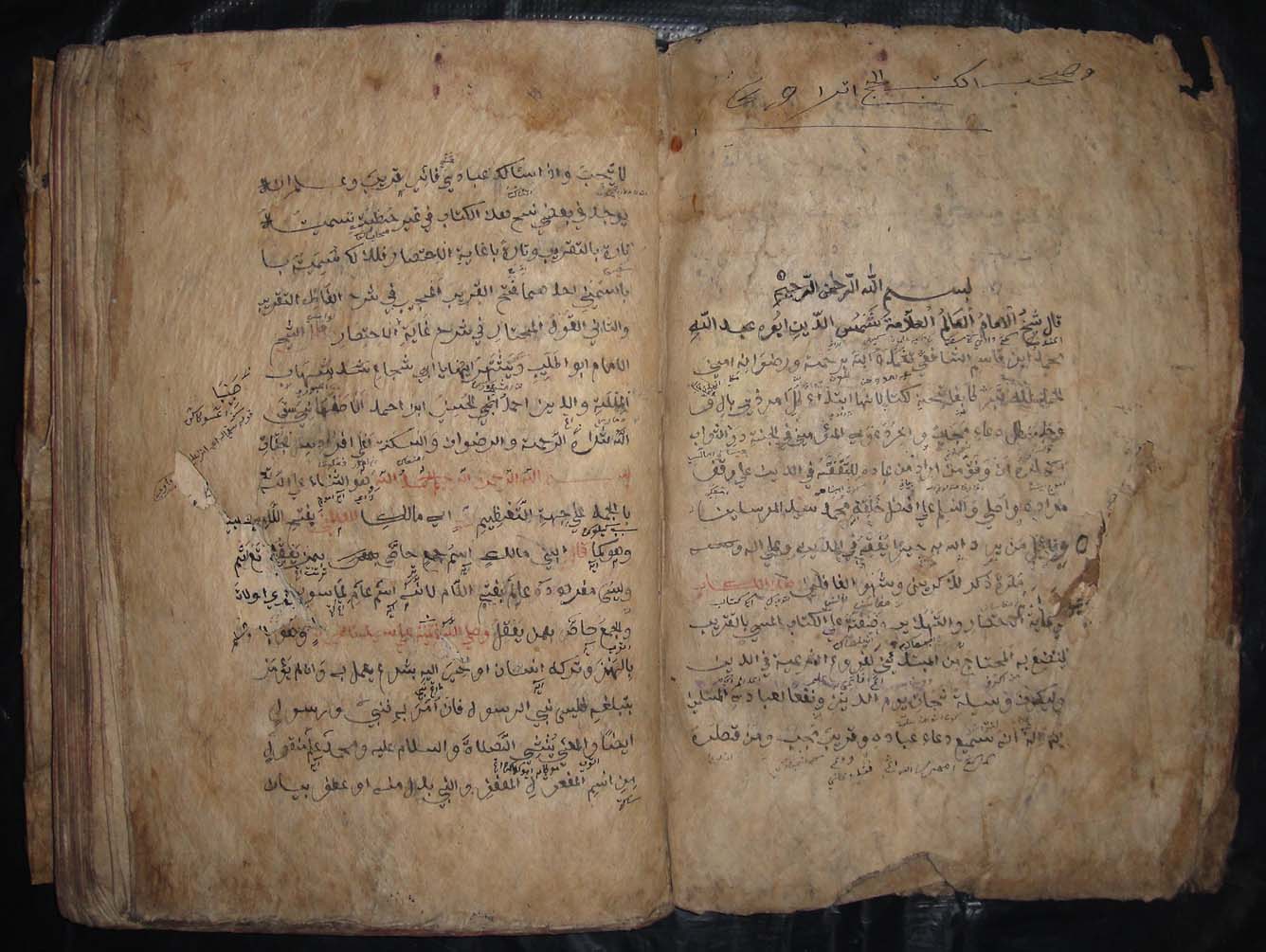
Ancient Manuscript Review 70 : Antique Malay Arabic Grammar Manuscript (18-19th century)


This is a written manuscript about Arabic grammar originated from South East Asia. Its believed to have been written in 18-19th century. Few pages of these manuscripts were heavily burrowed due to ages. Material used is Daluang paper.
Dluang (or Daluang) paper is a traditional paper made in the Indonesian region. It is a strong and very fibrous type of paper.  It  manufactured from the bark of the indigenous saeh tree.  The paper is somewhat coarse and displays natural defects (holes, thin spots and irregular edging).  When new, this paper is a light cream-colored brown.  In the the humid climate of the region, it darkens as it ages and will rot.
I acquired this manuscript from a friend in Indonesia quite a while ago.

Manuscript Specs

Item : Antique Malay Manuscript
Content : Arabic Grammar
Dim :  11.5"  x  8" x 1"
Date : 18-19th century
Copyist : anonymous
Origin : South East Asia
Calligraphy : Malay ?
Design : Written in Malay scripts in red & black with Arabic with some translation in Javanese
Purchased Price :US

Ancient Artifact Review 11 : Malacca "Swatow" shipwrecked plate ( 16-17th century)


This is a museum piece of shipwrecked plate retrieved from the Strait of Malacca ( off coast Malaysia). Typical Swatow wares are coarsely potted with crackled glaze. Swatow word is believed a Dutch mistranslations of word Shantou which is a place in Guandong province of China.
However recent findings by Chinese scholars led to believe that Swatow wares were produced in Zhangzhou China where was very famous in making and exporting wares to Europe, Japan & South East Asia between 16-17th century.
The unique thing about this plate is the motif executed in calligraphic stroke to resemble the word "ALLAH" in Arabic. This motif is believed intentionally designed for export to Malacca and other Malay Islamic kingdoms in south east asia.
The plate is 10" in diameter and 3" height.

Saturday, September 15, 2012

Ancient Coin Review 50 : Sultan Rijaludin Shah ( Kedah Sultanate 1625 - 1651 CE)


This is a gold coin from Sultan Rijaludin Shah era. He reigned Kedah from 1625 - 1651 CE.

Kedah is located in the northwestern part of Peninsular of Malaysia. The name of Kedah originated from the Sanskrit word Kadaram. It is also known by its Arabic honorific, Darul Aman ( Abode of Peace).  The sultanate was the earliest one on the Malay Peninsular as well as one of the oldest Sultanate in the world.

The kingdom began in 630CE as a Hindu Kingdom which the first king was Maharaja Derbar Raja who originally a defeated Persian king of Gemeron ( Bandar Abbas) who fled to Kedah. The people of Kedah found him to be a very smart & tactical man, so they entrusted him to lead them as the king of Kedah.
This kingdom is a Hindu kingdom however I couldnt find in any history book in regards to the faith of Maharaja Derbar Raja. In 630 CE, Gemeron is part of Sassanian Kingdom which Zoroastrian is the main religion.
Towards the end of 11th century, the 9th Kedah Hindu king, Dubar Raja II renounced Hinduism and conerted to Islam. He adpoted an Islamic name, Sultan Muzafar Shah and continued ruling Kedah from 1136 to 1179 CE. This sultanate continues to rule till today.
This mean the present Sultan of Kedah, Sultan Abdul Halim Muzaffar Shah has a direct link back to not just the first Kedah Sultan, Sultan Muzaffar Shah (1136CE) but also to the first Hindu Sultan , Maharaja Derbar Raja ( 630CE). Try to imagine someone with unbroken family lineage since 630CE till now. Unbelievable!!

As for this coin is concerned, the history of this coin is not yet published. When Saran Singh wrote his Coin Encyclopedia, this type of coin wasn't discovered yet. In his book, he only mentioned the coin during the time of Sultan Rijal was made of tin (pg254). Similar remark can be found in Bank Negara Malaysia coin catalog , Kedah & Perlis Currency Heritage ( pg 36). Until recently this coin emerged and was recognized as the product of Sultan Rijal Dewa Shah of 1625 CE.

Obv: Sultan Rijal
Rev: Shah Dewa
Weight : 0.63 gm
Dim : 10mm
Rarity : RRRR
Denom : Kupang
Material : Gold
Reference : Unpublished

Thursday, September 13, 2012

Ancient Manuscript Review 69 : Antique Persian Torah Scroll ( 500 years old)


This hand-written one of a kind Torah fragment is approximately 500 years old and has been beautifully preserved. These are the only red scroll fragments I have ever seen from Persia -- Extremely rare. Torah Fragments like these are seldom seen or available due to their age. Scrolls from Persia, are highly prized for the beauty of its soft colored parchment and their beautiful calligraphy. These parchments are so prized because they hold their ink well and the letters remain black and easy to read over centuries of use in a synagogue.
The piece measures approx. 20" x 5"
The scroll has an excerpt of Jacob leaves Laban to return to the land of his father
Genesis -Bereshit 31:1-31:30

Below is the excerpt of the Genesis 31: 1-30 from NIV


Jacob Flees From Laban

31 Jacob heard that Laban’s sons were saying, “Jacob has taken everything our father owned and has gained all this wealth from what belonged to our father.” 2 And Jacob noticed that Laban’s attitude toward him was not what it had been.3 Then the LORD said to Jacob, “Go back to the land of your fathers and to your relatives, and I will be with you.”4 So Jacob sent word to Rachel and Leah to come out to the fields where his flocks were. 5 He said to them, “I see that your father’s attitude toward me is not what it was before, but the God of my father has been with me. 6 You know that I’ve worked for your father with all my strength, 7 yet your father has cheated me by changing my wages ten times. However, God has not allowed him to harm me. 8 If he said, ‘The speckled ones will be your wages,’ then all the flocks gave birth to speckled young; and if he said, ‘The streaked ones will be your wages,’ then all the flocks bore streaked young. 9 So God has taken away your father’s livestock and has given them to me"10 “In breeding season I once had a dream in which I looked up and saw that the male goats mating with the flock were streaked, speckled or spotted. 11 The angel of God said to me in the dream, ‘Jacob.’ I answered, ‘Here I am.’ 12 And he said, ‘Look up and see that all the male goats mating with the flock are streaked, speckled or spotted, for I have seen all that Laban has been doing to you. 13 I am the God of Bethel, where you anointed a pillar and where you made a vow to me. Now leave this land at once and go back to your native land.’”14 Then Rachel and Leah replied, “Do we still have any share in the inheritance of our father’s estate? 15 Does he not regard us as foreigners? Not only has he sold us, but he has used up what was paid for us. 16 Surely all the wealth that God took away from our father belongs to us and our children. So do whatever God has told you.”17 Then Jacob put his children and his wives on camels, 18 and he drove all his livestock ahead of him, along with all the goods he had accumulated in Paddan Aram,[a] to go to his father Isaac in the land of Canaan.19 When Laban had gone to shear his sheep, Rachel stole her father’s household gods. 20 Moreover, Jacob deceived Laban the Aramean by not telling him he was running away. 21 So he fled with all he had, crossed the Euphrates River, and headed for the hill country of Gilead.
Laban Pursues Jacob
22 On the third day Laban was told that Jacob had fled. 23 Taking his relatives with him, he pursued Jacob for seven days and caught up with him in the hill country of Gilead. 24 Then God came to Laban the Aramean in a dream at night and said to him, “Be careful not to say anything to Jacob, either good or bad.”
25 Jacob had pitched his tent in the hill country of Gilead when Laban overtook him, and Laban and his relatives camped there too. 26 Then Laban said to Jacob, “What have you done? You’ve deceived me, and you’ve carried off my daughters like captives in war. 27 Why did you run off secretly and deceive me? Why didn’t you tell me, so I could send you away with joy and singing to the music of timbrels and harps? 28 You didn’t even let me kiss my grandchildren and my daughters goodbye. You have done a foolish thing. 29 I have the power to harm you; but last night the God of your father said to me, ‘Be careful not to say anything to Jacob, either good or bad.’ 30 Now you have gone off because you longed to return to your father’s household. But why did you steal my gods?”

Manuscript Specs

Item : A handwritten Torah Scroll
Content :Genesis -Bereshit 31:1-31:30
Dim :20" x 5"
Date : 15th century
Copyist : unknown
Origin : Persian
Calligraphy : Hebrew
Design : Text written in hebrew on thick red dear skin parchment in black.
Purchased Price :USD

Ancient Manuscript Review 68 : Antique Tauhid Manuscript in Javanese ( 19th Century)


This is a handwritten manuscript on Islamic Tauhid originated from Indonesia. It was written in Javanese language. The covers are made of thin brownish leather and seem to be original. No illuminations and no page missing. I acquired this manuscript from a friend in Indonesia about a few   years ago.

Manuscript Specs Item : Antique Malay Javanese Islamic Manuscript
Manuscript Content : Islamic Tauhid
Dim : 14" x 8.5" x 2.5"
Date : 18-19th century
Copyist : anonymous
Origin : Java island South East Asia
Calligraphy : Malay ?
Design : Written in Malay scripts in red & black
Purchased Price :US

Wednesday, September 12, 2012

Ancient Coin Review 49 : Ingot / Bidor Perak ( Perak Sultanate 16-19th century)


This is a bidor coin from Perak Sultanate as early as 16th century. This form of currency is called tin ingot. These ingots were casted of fixed weight and used for all major transactions in the bazaar as a form of currency.The value of each ingot depends upon its weight. By mid 1850's , ingots were gradually replaced by coinages.


Obv : An ornamental design of four rosettes based on the tampok manggis
Rev:  Blank
Weight : 1100 gm
Dim : 100 x 100 x 50 mm
Date : 16-19th century
Rarity : RRR
Denom : 1 tampang           
Material : Tin
Reference : SS38  pg 199 ( The Encyclopedia of the Coins)

Ancient Manuscript Review 67 : Antique Indian Lithographed Quran ( 1324 AH)


This is a beautifully lithographed Quran originated from Indian region. I know this is not under manuscript category however its heavy illuminations quite fascinating so I decided to post it up in here. Its dated 1324 AH = 1906 CE.
I acquired this Quran from a friend last year.


Manuscript Specs Item : Antique Indian Lithographed Quran
Manuscript Content : Quran
Dim : 7.5" x 5.5" x 1.5"
Date : 1324 AH ( 1906 CE)
Copyist : indechpierable
Origin : India
Calligraphy : Naskh
Design : 15 lines in black
Purchased Price :US

Ancient Coin Review 48 : Sultanah Nurul Alam ( Acheh Sultanate 1675-1678 CE)


This is a gold coin from Sultanah Nurul Alam Nakiat Din Shah era. She is the second female to be throned in Aceh Sultanate. She reigned Aceh from 1675 - 1678 CE.
Aceh is a state located at the northern end of Sumatra island ( Indonesia). It is also known by its Arabic honorific Darus Salam ( Abode of Peace) from 1511-1959 CE.
Aceh's origins are unquestionably Cham, as the Champa king Syah Pau Kubah sent his son Syah Pau Ling to rule over Aceh when the capital Vijaya in 1471 AD, was sacked by the Vietnamese Le Dynasty.
The Sultanate of Aceh was founded in 1511 CE after the fall of Pasai Sultanate by Sultan Ali Mughayat Shah. It’s presumed that he is the same person as Syah Pau Ling who converted to Islam.
The Sultanate lasted till 1903 when the last Aceh Sultan Muhammad III Daud Shah Johan Berdaulat surrendered to Dutch occupation.

Obv: Nakiat Din Berdaulat Shsh
Rev: Paduka Sri Sultanah Nur Alam
Weight : 0.60 gm
Dim : 1675 - 1678 CE
Rarity :
Denom : Mas
Material : Gold
Reference : A 18 pg 178 ( Jaarboek Voor Munt-en Penningkunde)

Ancient Manuscript Review 66 : Antique Handwritten Javanese Quran ( 18-19th century)


This is a beautifully written Quran manuscript originated from South East Asia. The centrepieces design is typical of Java island Indonesia. The cover is made of thin brownish leather and is glued on a hard board. The frontispieces & finishpieces are glued to the inner cover on both sides. first few pages on the beginning and ending of the Quran are missing. I acquired this manuscript from a friend in Indonesia last year.


Manuscript Specs Item : Antique Malay Javanese Quran
Manuscript Content : Quran
Dim : 14" x 8.5" x 2.5"
Date : 18-19th century
Copyist : anonymous
Origin : Java island  South East Asia
Calligraphy : Malay ?
Design : Written in Malay scripts in red & black
Purchased Price :US

Tuesday, September 11, 2012

Ancient Artifact Review 10 : Antique Malay Carved Wooden Doors ( 1911 CE)


These are 2 pairs of beautifully carved wooden doors. I purchased these doors from a friend in Kuala Lumpur.
However in this posting I posted only the first pair of the door. The other door will be posted on a separate entry.
 These doors were from a mansion in Balik Pulau. On one panel, there was an Arabic inscription of year 1331 H which is equivalent to 1911 CE. However my friend didnt purchase the panel since it was none of his interest at that time and even before selling these doors last July.
The first set of door has its each leaf dimension of 76 x 17.5 inches whereas the other set of 76 x 16.5 inches.

Ancient Artifact Review 9 : Antique Akkadian Clay Tablet ( 2350-2150BC)


This is a genuine ancient clay tablet with old Akkadian inscription from 2350-2150BC. I purchased this item from a reputed seller of an auction about 10 years ago.
Besides Egypt, Mesopotamia also adopted cuneiform writing in their literary system.
When I purchased this item, it was in a good condition. However due to the weather where this item was stored, some of the fragments were chipped off. I have lost the document in regards to the content of this inscription, however I still remember that it was regarding the prayer for constructing a building or so.
The front side is full of incused inscription in old akkadian language whereas the back is blank.
Dimension is 120mm x 60mmx30mm

Below is an excerpt I quoted from Wikipedia in regards to this clay tablet tradition :


"In the Ancient Near East, clay tablets (Akkadian ṭuppu(m) 𒁾[1]) were used as a writing medium, especially for writing in cuneiform, throughout the Bronze Age and well into the Iron Age.
Cuneiform characters were imprinted on a wet clay tablet with a stylus often made of reed (reed pen). Once written upon, many tablets were dried in the sun or air, remaining fragile. Later, these unfired clay tablets could be soaked in water and recycled into new clean tablets. Other tablets, once written, were grilled in a kennal or fired in kilns (or inadvertently, when buildings were burnt down by accident or during conflict) making them hard and durable. Collections of these clay documents made up the very first archives. They were at the root of first libraries. Tens of thousands of written tablets, including many fragments, have been found in the Middle East.[2][3]
In the Minoan/Mycenaean civilizations, writing has not been observed for any use other than accounting. Tablets serving as labels, with the impression of the side of a wicker basket on the back, and tablets showing yearly summaries, suggest a sophisticated accounting system. In this cultural region the tablets were never fired deliberately, as the clay was recycled on an annual basis. However, some of the tablets were "fired" as a result of uncontrolled fires in the buildings where they were stored. The rest are still tablets of unfired clay, and extremely fragile; some modern scholars are investigating the possibility of firing them now, as an aid to preservation."

Ancient Artifact Review 8 : Antique Aramaic Incantation Bowl


I purchased the incantation bowl pieces from EBAY few years ago. The reason I purchased these pieces because there are Aramaic inscription on them since I am very much fascinated with Semitic languages. This language is the language spoken by Prophet Jesus pbuh during his era.
These are 2 fragments of the Incantation bowl with readable Aramaic in many lines. Dimension approx. 97mm x 51mm & 28mm x 38mm

Monday, September 10, 2012

Ancient Manuscript Review 65 : Antique Sulawesi Handwritten Quran ( 18-19th century)


This is a beautifully written Quran manuscript originated from South East Asia. Specifically it could be from Sulawesi island judging from the design which is typical of its kind. Its believed to have been written in 18-19th century. This manuscript is written in Malay calligraphy. However few pages from the beginning and the ending of this manuscripts are missing. In the middle of the manuscript particularly the beginning of surah AL Kahf, the pages were illuminated with beautiful colors. Looking at this manuscript, I almost thought it was from Terengganu of origin. However Dr Annable Gallop advised me that this manuscript most probably from Sulawesi due to its design. The covers of this Quran were believed to be original but they were loose and were taped to the outer spine. The cover is made of thin brownish leather and is glued on a hard board. I acquired this manuscript from a friend in Indonesia last year.

Manuscript Specs Item : Antique Malay Sulawesi Quran
Manuscript Content : Quran
Dim : 14" x 8.5" x 2.5"
Date : 18-19th century
Copyist : anonymous
Origin : Sulawesi South East Asia
Calligraphy : Malay ?
Design : Written in Malay scripts in red & black
Purchased Price :US

Islamic Codicology Certificate


I attended an Intensive Islamic Codicology Course last week at Cambridge University. I am extremely happy with the course and the workshop. All lectures are very helpful in equipping me with basic yet necessary knowledge in handling ancient manuscripts. The main lecturer, Prof Francois Deroche is very experienced & knowledgable in ancient islamic manuscripts. He also has refreshing and dynamic views in analyzing and scrutining these antiquities. I am glad I went to this course and the long journey ( ABu Dhabi - Cambridge) is worth it.


Thursday, August 30, 2012

TIMA Islamic Codicology Course at Cambridge University


I am looking forward to attending this course , Islamic Codicology, to be held at Cambridge University next Monday, 3 September. I have enrolled for this course since last year and had been looking forward to it since. This is the quickest and the fastest way for a naive manuscript collector like me to understand and know more about ancient islamic manuscripts.
      This is a 1 week course - lectures & hands-on - will be guided by prominent experts. Some might wonder what is codicology. Below is a definition from wikipedia :

"Codicology (from Latin cōdex, genitive cōdicis, "notebook, book"; and Greek -λογία, -logia) is the study of books as physical objects, especially manuscripts written on parchment (or paper) in codex form. It is often referred to as 'the archaeology of the book', concerning itself with the materials (parchment, sometimes referred to as membrane or vellum, paper, pigments, inks and so on), and techniques used to make books, including their binding."

Below link is the details of this course :

http://www.islamicmanuscript.org/training/2012CodicologyShortCourse.html