A journey to search my soul

This is a blog of my personal collections. The purpose of this blog is to educate myself and public in regards to antiquities especially related to religion and calligraphy. I welcome everyone to input their feedback in this blog which they think would be helpful. I do not watermark the photos in this blog so everyone is free to use them as long as they are not used for illegal and unethical reasons. I appreciate if you could notify me if you plan to use any of the photos here. Enjoy browsing!!

Sunday, December 13, 2015

Ancient Manuscript Review 173 : Antique Ottoman Era document / Letter ( 18-19th century)


This is a document written in old Turkish. The document was originally folded and sealed. I couldn't figure out what type of document this is. It could be a legal document or a personal ones. It could be from 18-19th century based on similar dated documents that came with it.  It is written in Riqaah script in black.
I dont have much information of this kind of manuscript and its writing tradition. I need to do more research on this manuscript and will update this entry later. I welcome any feedback on this letter.

My other similar document is in below link
Ottoman Letter

Manuscript Specs

Item : Ottoman document
Content :  Unknown
Dim : 12" x 8.5"
Date : 18-19th century
Copyist : indechiperable
Origin :  Turkey
Calligraphy : Riqaah
Design :
Purchased Price :US

Saturday, December 12, 2015

Ancient Artifact Review 60 : Antique Ottoman Pen Case ( Divit) dated 1351 AH


This is an old Ottoman Pen case / Qalamdan ( Divit) which measures  8" long with an inkwell at one end. It is beautifully decorated with floral motives. Made of brass and dated 1351 AH or equivalent to 1932 CE. I don't see any Tugra motif on this case unlike my other Qalamdans.


Compare with another bigger Ottoman Divit / Qalamdan
Giant Ottoman Divit
Medium Ottoman Divit


Dim : 8in
Date : 1351 AH (1932 CE)
Material : Brass
Origin : Turkey

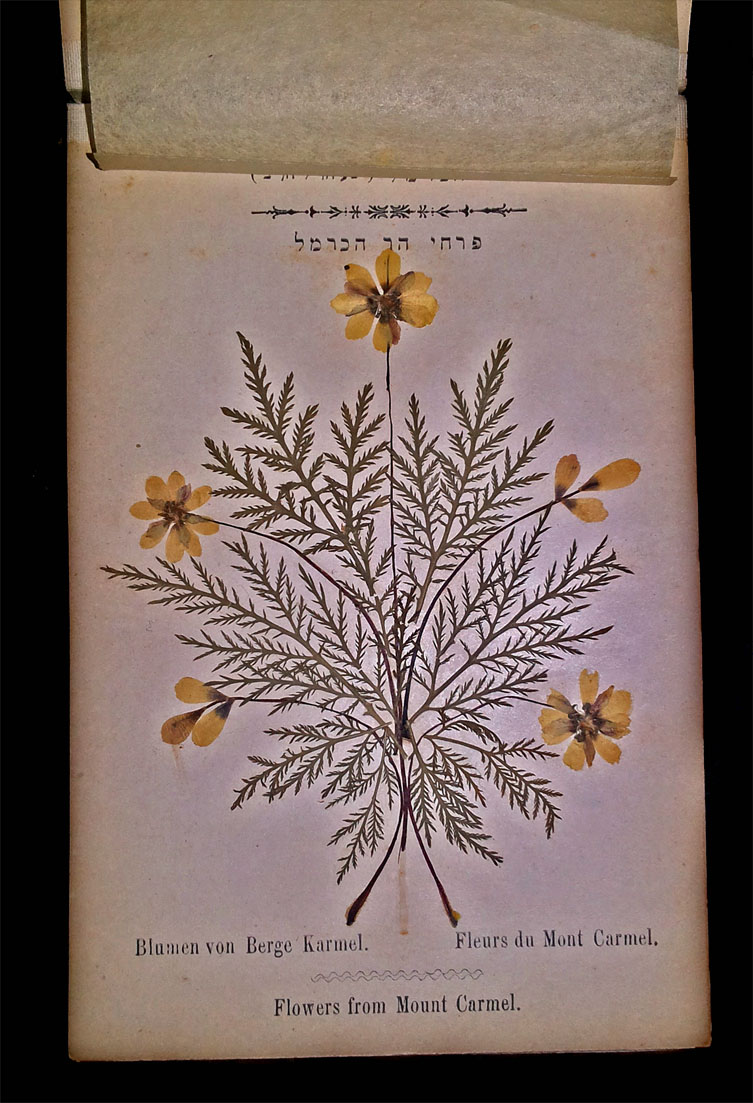
Ancient Manuscript Review 172 : Antique Album of Flowers from Jerusalem c. 1900s


This is a rare antique album of real pressed flowers collected from 12 important places in Jerusalem.
The flowers and leaves are arranged beautifully on captioned card and have been well preserved for more than 100 years.
The album is cloth bound with covers made of thick polished olive wood and spine of leather.
The album is supposed to be open from the right cover where the word Jerusalem in English and Hebrew are painted with multicolored inlay border.
Each plate is captioned in Hebrew, English, German and French.
The titles of the plates are :
1)Flowers from Jerusalem
2) Flowers from Mount Sion
3) Flowers from Mount Moriah
4) Flowers from Siloah
5) Flowers from the grave of Rachel
6) Flowers from Hebron
7) Flowers from  the Mount of Olives
8) Flowers from the Valley of the Jordan
9) Floweres from Mount Carmel
10) Flowers from Saron,
11) Flowers from the Mount of Gerizim
12) Flowers from the Mount Hermon.

Album measures 4 1/4 x 6 1/2 inches and is in excellent condition with only light surface wear and a few pieces of the mosaic missing from the corner areas.


Friday, December 11, 2015

Ancient Manuscript Review 171 : Antique Kufic Quran on Vellum / Parchment ( 10th Century)


This is a vellum with both sides written Quranic verses in Kufic script. Acquired from an acquaintance in Paris. The vellum originally belonged to a Professor of Islamic Art. I couldn't verify the exact date of this vellum however based on the script (Kufic), I would estimate it around 9th -10th century CE based on the type of calligraphy. The leaf was in 3 fragments.

Codicology
Title Page : Nil
Content    : Quranic Verses
Date         : 9th-10th Century CE
Copyist    : Anonymous
Patron      : Nil
Origin      : Near East or North Africa
Place acquired : Paris
Illuminations : Nil
Calligraphy :Kufi
Number of lines :6 lines per page
Inks          : Main text in red
Punctuation: Diacritical marks in red.
Frame       :  Nil
History of Manuscript : Originally belonged to a Professor of Islamic Art in Paris. His family sold some of these vellums to a friend. I acquired this vellum from him in 2013.
Number of folios : 1 f
Support of writing : light redish vellum
Gatherings : N/A
Catchwords :Nil
Dimensions : 22.0 cm x 18.0 cm
Binding   : Nil
Estimated Market Price :
Purchased Price : USD
Remarks : 

Sunday, December 6, 2015

Ancient Artifact Review 59 : Antique Malay Gold Threaded Pillow Ends / Tekat / Tampok Bantal ( early 20th Century)


These are 2 Malay artworks called tekat. It is a gold thread embroidery practiced by the Malay from Malaysia.  These beautiful pieces are sewn onto both ends of a bolster ( bantal peluk) as part of  the bridal decorations which is typical in Malay weddings. Traditionally, to have the entire bridal daise and chamber decoration done in tekat is almost a must. These days, one doesn't have to worry about creating a tekat arrangement for the wedding. In Malay wedding, its customary to use the service of "Mak Andam" or a wedding planner. They have almost complete bridal decorations arrangement and lend them out for a very reasonable price.
Tekat originally was a court art and gained popularity by the 15th Century. It was thought that this art originated from Ottoman Empire and brought into the royal court of the Malay Kingdom by the traders.
In this sample, the gold thread was stitched in a patterned way over a piece of of a maroon velvet fabric. Motifs of foliage and floral were used as Islam prohibits using animal motifs. I believed these samples from early 20th Century CE.
As we can see from my other entries , some bolsters' ends are sewn with decorated metal plates. Below are the links to the plates :

Malay Plate 01
Malay Plate 02

Compare this plate with Peranakan plates in below link
Peranakan Tampok Bantal

Specification :
Description : Malay bolster Tekat
OD : 4 inches
Material : Gold Thread on maroon velvet fabric
Ref :  Islamic Civilization In The Malay World (pg 325)

Thursday, December 3, 2015

Ancient Artifact Review 58 : Antique Etiopia Priest Leather Bible Carrying Case / bag ( 18th Century)


This is an old leather bag used to carry an Etiopian Psalter. This typical bag normally made for the priests. Dimension of 220mm x 140mm made of goat leather and sides were sewn with leather strings. It comes with closing flaps at the top and leather string attached on both sides.


Item Spec :

Item : Antique Etiopia  Bible Carrying Case
Description : A leather bag made of goat skin.
Dim : 220mm x 140mm
Date : 18th century CE
Origin : Etiopia
Purchased Price :US

Tuesday, November 24, 2015

Ancient Coin Review 89 : Sultanah Taj Alam ( Aceh Sultanate 1641-1675 CE)


This is a gold coin from Sultanah Taj Alam Safiat AdDin Shah era. She is the first female to be throned in Aceh Sultanate. She was a widow of Sultan Iskandar Thani. She reigned Aceh from 1641 - 1675 CE.

Looking at the Arabic calligraphy used, its quite tricky as the calligraphy is compressed to fit on the coin face. However it has the resemblance to Thuluth & Sini. Or probably this is how Malay calligraphy was derived.
Obverse : فادك سر يلطانه تاج العالم     
                 Paduka Sri Sultanah Taj Al Alam
Reverse : صفية الدين بردولة شاه
                Safiat Aldin Berdaulat Shah


Aceh is a state located at the northern end of Sumatra island ( Indonesia). It is also known by its Arabic honorific Darus Salam ( Abode of Peace) from 1511-1959 CE.
Aceh's origins are unquestionably Cham, as the Champa king Syah Pau Kubah sent his son Syah Pau Ling to rule over Aceh when the capital Vijaya in 1471 AD, was sacked by the Vietnamese Le Dynasty.
The Sultanate of Aceh was founded in 1511 CE after the fall of Pasai Sultanate by Sultan Ali Mughayat Shah. It’s presumed that he is the same person as Syah Pau Ling who converted to Islam.
The Sultanate lasted till 1903 when the last Aceh Sultan Muhammad III Daud Shah Johan Berdaulat surrendered to Dutch occupation.

Look my other variation of this coin in below link :
Taj Alam 9


Obv:   فادك سر يلطانه تاج العالم    Paduka Sri Sultanah Taj Alam
Rev:   صفية الدين بردولة شاه   Safiat Ad Din Berdaulat Shah
Weight : 0.61 gm
Dim : 1641 - 1675 CE
Rarity :
Denom : Mas
Material : Gold
Reference : A 17a type 1 pg 177 ( Jaarboek Voor Munt-en Penningkunde)

Ancient Coin Review 88 : Sultanah Kamalat Shah ( Aceh Sultanate 1688-1699 CE)


This is a gold coin from Sultanah Kamalat Shah era. She is the fourth female to be throned in Aceh She reigned Aceh from 1688 - 1699 CE.
After protests from people who wanted a male sultan, especially after a fatwa from a Kadi in Mecca  stating that a woman as a head of state is in conflict with the laws of Islam, she was desposed in October 1699.
Looking at the Arabic calligraphy used, its quite tricky as the calligraphy is compressed to fit on the coin face. However it has the resemblance to Thuluth & Sini. Or probably this is how Malay calligraphy was derived.
Obverse : فادك سر يلطانه كمالة شاه
                Paduka Sri Sultanah Kamalat Shah
Reverse : زينة الدين بردولة شاه

                Zainat Aldin Berdaulat Shah


Aceh is a state located at the northern end of Sumatra island ( Indonesia). It is also known by its Arabic honorific Darus Salam ( Abode of Peace) from 1511-1959 CE.
Aceh's origins are unquestionably Cham, as the Champa king Syah Pau Kubah sent his son Syah Pau Ling to rule over Aceh when the capital Vijaya in 1471 AD, was sacked by the Vietnamese Le Dynasty.
The Sultanate of Aceh was founded in 1511 CE after the fall of Pasai Sultanate by Sultan Ali Mughayat Shah. It’s presumed that he is the same person as Syah Pau Ling who converted to Islam.
The Sultanate lasted till 1903 when the last Aceh Sultan Muhammad III Daud Shah Johan Berdaulat surrendered to Dutch occupation.


Look my other variation of this coin in below link :
Kamalat Coin Unlisted

Obv: فادك سر يلطانه كمالة شاه  Paduka Sri Sultanah Kamalat Shah
Rev: زينة الدين بردولة شاه  Zakiat Ad Din Berdaulat Shah
Weight : 0.61 gm
Dim : 14mm
Date : 1688 - 1699 CE
Rarity :
Denom : Mas
Material : Gold
Reference : A 20 type B pg 179 ( Jaarboek Voor Munt-en Penningkunde)

Sunday, November 22, 2015

Ancient Manuscript Review 170 : Antique Kufi Quran Patron Page Saadi Dynasty ( 16th-17th Century )


This is an illuminated page found in one of my Maghribi Quran from Saadi era. It is beautifully colored with natural dye and I believe the patron name is written in Kufi in the middle.
 It reads محمد بركة  ( Muhammad Barkat).


Dim : 200mm x 180mm
Date : 16th Century CE (Saadi Dynasty)
Material : Western Paper
Origin : Morocco

Saturday, November 21, 2015

Ancient Artifact Review 57 : Antique Qajar Persian Qalamdan Lacquered Box 18th century

This is an old Persian Paper Mache box which measures 210mm x 64mmx 45mm originating from Qajar. This box could probably serve as pen case or Qalamdan.
It is beautifully lacquered in a floral motif with beautiful bright colors.
The box painted in polychrome and gilt,  covers and sides with bulbuls perched amidst wild roses and apple blossoms.


See my other Lacquered boxes on below links
Qajar Qalamdan
Persian Qalamdan

Dim : 210mm x 64mm x 45mm
Date : 18th Century CE ( Qajar Persia)
Material : papier-maché
Origin : Afghanistan

Thursday, November 19, 2015

Book Review 14 : The Significance of Islamic Manuscripts - Al Furqan Islamic Heritage Foundation


Book Info :

Title : The Significance of Islamic Manuscripts
Author : Various authors
Publisher : Al Furqan Islamic Heritage Foundation
Printer :
Pages : 180 pages
ISBN :1-873992-05-X


Review :

This is an excellent book published proceeding from the Inaugural Conference of Al Furqan Islamic Heritage Foundation held in London from 30th November -1st December 1991.
Its collections of 12 papers presented by eminent scholars from all over the world in regards to Islamic manuscripts.
Below are the title of the papers :
1)  Manuscripts in Historical Research and Text Edition
     by Wilfred F. Madelung
2)  The Significance of Islamic Manuscripts
     by Seyyed Hossein Nasr
3)  Persian Manuscripts with Special Reference to Iran
     by Iraj Afshar
4)  Collections of Islamic Manuscripts in the Former Soviet Union & their Cataloging
     by Anas Baqi Khalidov
5)  Islamic Manuscripts in the West
     by Angelo Michele Piemontese
6)  Turkish Manuscripts and the Publication of their Catalogues
     by Ramazan Sesen
7)  Classification of Andalusian & Maghribi Books of Nawazil from mid 5th to end 9th Century AH
     by Muhammad Al Habib Al Hilah
8)  A Study on the Manuscript Translations of the Holy Quran
     by Ekmeleddin Ihsanoglu
9)  Manuscripts in the History of Makkah and Madinah
     by Hamad Al Jasir
10)Some Remarks on Islamic Scientific Manuscripts & Instruments, Past Present & Future Research
     by David A King
11)Islamic Philosophical Manuscripts
     by Mehdi Mohaghghegh
12)Rare Literary Manuscripts in the Library of Abd Al Qadir Al Baghdadi
     by Abdul Aziz Ahmed AL Rifai

I bought this book during my visit to Islamic Arts Museum In Kuala Lumpur few years ago.

Tuesday, November 17, 2015

Ancient Coin Review 87 : Sultan Alaudin Riayat Shah 1- Johor Sultanate ( 1527 - 1564CE)

This is my 4th  gold coin SS2 type from Sultan Alaudin Riayat Shah era. He was the son of the last Malacca Sultan, Sultan Mahmud Shah who fled from Malacca after the invasion of Portugese. He became the first ruler of Johor Empire in 1527CE.he set up his capital at Johor Lama situated on the Johor river. He promoted foreign trade and was able to attract a fair amount of commerce. However Johor was captured by Acheh in 1564CE and became its vassal state until the collapse of the Acheh Empire in 1641CE.


Looking at the Arabic calligraphy used, its quite tricky as the calligraphy is compressed to fit on the coin face. However it has the resemblance to Thuluth & Sini. Or probably this is how Malay calligraphy was derived. I noticed also similar calligraphy was used on the tombstone ( pic edited from artmelayu.bs) of the same Sultan in Johor except all vertical alphabets were elongated to fill the column.


As for this coin, there are some errors in the words used.
Notice the Sultan is written ثلطان  instead of سلطان
The word choice mu'min for singular is used instead of mu'minin for plural


 My other similar coins are in below link
Sultan Alauddin I
Sultan Alauddin I
Sultan Alauddin I

Octagonal gold coin ( kupang) under the rule of Johor Sultan Alaudin Riayat Shah 1 (1527-1564AD).


Similar coin was sold for SGD750 ( USD550) in Lot 189 in the Collectibles Auction Asia (CAA) Auction 5/2015 held on 18 April 2015 at Landmark Village Hotel, Singapore.


Obv: Sultan Alaudin سلطان علاالدين
Rev: Khalifatul Mukmin Shah   خليفة الموْمن شاه
weight : 0.64gm
Dim : 12mm
Rarity : RR ( ref SS2)
Market Price : USD550

Monday, November 16, 2015

Ancient Artifact Review 56 : Antique Ottoman Calligraphers' Scissors (19th Century)


This pair of scissors is a part of calligrapher kits. The scribes normally have 2 type of scissors; the first one is called a calligrapher scissors and the second one is called book binder scissors.
The one in this review is the first one which is the calligrapher scissors.
This scissors is used to cut thin paper. It has long and thin blades so that it can cut a thin paper with a single move. When their blades are closed and on each other, they look as if to have a single blade.


The scissors in review is made of steel and ornamented in gold.The inlays have floral & foliate motives on both side of the scissors. Handles are made of brass.
See my other Ottoman scissors at


Ottoman Scissors


Artifact Specs

Item : Antique  Ottoman Calligrapher Scissors
Description : A pair of steel scissors with floral & foliate gold inlaid and brass handles
Dim : 260mm
Date : 18-19th century
Origin : Turkey
Purchased Price :US

Ancient Artifact Review 55 : Antique Islamic Indian Talismanic Bowl ( 20th Century)


This is a brass bowl serve as a talismanic purpose. Purchased from Jonker street Malacca but originated from India. Etched with Mosque's dome and minaret  on the outer bowl whereas the inner side is etched with Quranic verses particularly surah Al Ikhlas. This bowl could be from 20th Century.
See my other Talismanic bowl at
Malay Indian Talismanic Bowl
 
Dim : 100mm Diameter x 80mm height
Date :  20th Century
Material : brass
Origin : Indian
Price : RM sr

Monday, November 2, 2015

Ancient Manuscript Review 169 : Antique Indian Hindu Palm Leaf Manuscript ( 18th Century)


This is another manuscript written in palm leaf. However this time this manuscripts originated from Chennai India. I acquired this manuscript during my trip to Chennai early this year.
The leaf derives from the palmyra species of palm, especially Talipot Palm, which is common in India.
Both sides of palm leaf provide a writing surface. An iron stylus is used to inscribe the writings on the leaf surface.
See below the info on metal stylus :

Iron Stylus

I dont have any information about the content of this manuscript but I believe its about Hinduism. The manuscript was acquired from an abandoned temple in Chennai.
Each leaf is 14.5" in length and 1.0" in width. There are total of 50+ leaves and secured by an orange string. The covers are missing.

Compare this manuscript with similar manuscripts from Indonesia below :
Bali Lontar 01
Bali Lontar 02
Bali Lontar 03
Quran Lontar

Manuscript Specs

Item : Antique Hindu Palm Leaf Manuscript
Content : Hindusim
Dim : 14.5" x  1"
Date : 18-19th century
Copyist : anonymous
Origin : Chennai, India
Calligraphy : TBA
Design :
Purchased Price :US

Ancient Manuscript Review 168 : Antique Mongolia Buddha Sutra in Uighur script (18th Century)


These are 2 follios from Mongolia Buddha Sutra. The thing that make these follios attractive to me is the usage of Syriac-resemblance script in most of Mongolia manuscripts.
Unlike Aramaic or Syriac script which is written from right to left, the Uighur script is written from top to bottom adapting the way Chinese scripts are written and read.

See below an excerpt from Linguamongolia website :

The Mongolian (Uighur) Script

Over the last 800 years Mongolian has been written with a variety of different scripts, but the first of those and the most enduring is the one which the Mongols borrowed from the Uighurs. The Uighurs themselves had acquired this script as a result of their contacts with the Sogdian's, an Old Iranian people who had in turn borrowed their script from Syriac. Those who are already familiar with Syriac will easily see the similarities. However, where Syriac and Sogdian were written horizontally right to left, Uighur and Mongolian are written vertically left to right. According to Mongol tradition, this script was instituted at the order of Chinggis Qaghan in 1204. Many attempts were made to supplant it, with various scripts, mainly under the influence of Tibetan Buddhism and several scripts were adopted as variations of Tibetan and Sanskrit. The old script was eventually abandoned in the former Mongolian People's Republic where, in 1941, it was replaced by a variation of the Cyrillic alphabet. This loss of status has extremely weakened its position in Outer Mongolia, where generations have now grown up knowing nothing but Cyrillic; there have been attempts to revive its use, but these have not been overly successful.
However, it is still used by a relatively large section of the Mongolians living in the Inner Mongolia autonomous region of China, where the script can be found everywhere including bilingual road signs and on almost every storefront and fast-food outlet

Compare the script with Syriac script serto in my Syriac manuscripts as below :


Illuminated Antique Syriac Manuscript
Dated Antique Syriac Manuscript
Antique Syriac Manuscript


Codicology
Title Page : Unknown
Content    :  Buddha Sutra
Date         : 18th CE
Copyist    : Anonymous
Patron      : Nil
Origin      : Mongolia
Place acquired : USA
Illuminations : Nil
Calligraphy : Uighur
Number of lines :20 lines per page
Inks          : Main text in black
Punctuation: Diacritical marks in black
Frame       :  Red line
History of Manuscript : Purchased from Ebay
Number of folios : 2 ff
Support of writing : brownish oriental paper
Gatherings : N/A
Catchwords :
Dimensions : 265 mm x 90 mm
Binding   : Nil
Estimated Market Price :
Purchased Price : USD
Remarks :