A journey to search my soul

This is a blog of my personal collections. The purpose of this blog is to educate myself and public in regards to antiquities especially related to religion and calligraphy. I welcome everyone to input their feedback in this blog which they think would be helpful. I do not watermark the photos in this blog so everyone is free to use them as long as they are not used for illegal and unethical reasons. I appreciate if you could notify me if you plan to use any of the photos here. Enjoy browsing!!

Wednesday, December 23, 2015

Ancient Manuscript Review 175 : Antique Quran Frontispiece Page Saadi Dynasty ( 16th-17th Century )


This is an illuminated page or a frontispiece found in one of my Maghribi Quran from Saadi era. It is beautifully colored with natural dye and decorated with symmetrical foliage.
In this frontispiece, overall design is fully covered with leafy shoots with curling, flat, rounded and pointed leaves, joined to a stem which is covered by their movement.
In the middle of this page, these foliates are overlapping each other and forming a geometric design forming 8-point star.
Colors used in this design are red, turquoise, white, gold and yellow


Compare the other illuminated page from the same manuscript below

Maghribi Quran Patron Page


Dim : 200mm x 180mm
Date : 16th Century CE (Saadi Dynasty)
Material : Western Paper
Origin : Morocco
Ref : Royal Illuminated Manuscripts of Morocco

Saturday, December 19, 2015

Ancient Coin Review 93 : Sultan Zainal Abidin III Terengganu Pitis / Keping Coin dated 1310AH ( 1892 CE)


This is a rare pitis coin from Sultan Zainal Abidin III era. He became the ruler of Terengganu from 1881 - 1918 CE.
This is a coin from his era value at 10 Keping dated 1310AH which is equivalent to 1892 CE. From Saran's Catalog as well as Dr Ibrahim's, this coin is type SS15 however there is a slight different in the shape of the ک "kaf" where it is more flat than in Saran's. In addition to that the beginning of the س "sin" started with an elongated vertical stroke whereas its a short stroke in Saran's. It was also not captured in Bank Negara Malaysia, Terengganu Currency Heritage Catalog. Could this coin be rare?
The Arabic calligraphy used on this coin definitely a Thuluth type due to angular shape of the script. Dechipering from the script above, the inscriptions on the obverse is in Arabic whereas the reverse is in Malay :
Obverse :   ضرب في ترقانو ٠ ١ ٣ ١
                 Struck in Terengganu 1310 AH
Reverse : سفوله کفيڠ ٠ ١
                 Sepuluh Keping 10

Compare with my other Terengganu Coin from previous Sultan
Terengganu SS11
Terengganu SS33
Terengganu Unlisted

Terengganu was an important trading centre in the 13th Century. Later it became a vassal state of the Majapahit Empire of Java. By the end of the 14th Century, a Muslim community is known to have flourished in Terengganu. Subsequently, it became a tributary state of the Malacca Empire in the 15th Century.After the fall of Malacca Empire, Terengganu was claimed by the Johor Empire as part of the territories inherited from the former Malacca Empire.In the 17th Century, Johor ruler's brother was proclaimed as the first ruler of Terengganu. ( from Saran Singh's)

 
Coin Spec :


Obverse :   ضرب في ترقانو ٠ ١ ٣ ١
                 Struck in Terengganu 1310 AH
Reverse : سفوله کفيڠ ٠ ١
                 Sepuluh Keping 10
Weight : 5.60gm
Dim : 27mm
Rarity : Different Variety from the catalog
Denom : Pitis
Material : Tin
Reference : SS15 but it is different variety than the one in catalog

Wednesday, December 16, 2015

Ancient Manuscript Review 174 : Antique Etiopian Ge'ez Coptic Handwritten Gospel / Bible on Vellum (18th century)


This is a Coptic Gospel / Bible written on vellum in Ge'ez language. I really dont know how to read this script. But the seller who is coptic herself told me that this is a gospel written in Ge'ez.
There are 2  pages with Iconic drawing showing the scenes of the last supper and the crucifixion. The entire folios are made of most likely goat skin.
Click this link to see my other Coptic Bible
Coptic Bible
Coptic Bible
Coptic Gospel 1
Coptic Gospel 2
Coptic Gospel 3


This is what I got from Wiki some infos on the origin of this language.

The Ge'ez language is classified as a South Semitic language. It evolved from an earlier proto-Ethio-Semitic ancestor used to write royal inscriptions of the kingdom of Dʿmt in Epigraphic South Arabian. The Ge'ez language is no longer universally thought of, as previously assumed, to be an offshoot of Sabaean or Old South Arabian,[13] and there is some linguistic (though not written) evidence of Semitic languages being spoken in Eritrea and Ethiopia since approximately 2000 BC.[14] However, the Ge'ez script later replaced Epigraphic South Arabian in the Kingdom of Aksum (Epigraphic South Arabian letters were used for a few inscriptions into the 8th century, though not any South Arabian language since Dʿmt). Early inscriptions in Ge'ez and Ge'ez script have been dated[15] to as early as the 5th century BC, and in a sort of proto-Ge'ez written in ESA since the 9th century BC. Ge'ez literature properly begins with the Christianization of Ethiopia (and the civilization of Axum) in the 4th century, during the reign of Ezana of Axum.[citation needed]

5th to 7th centuries

The oldest known example of the old Ge'ez script is found on the Hawulti obelisk in Matara, Eritrea. The oldest surviving Ge'ez manuscript is thought to be the 5th or 6th century Garima Gospels.[16][17]
Almost all texts from this early "Aksumite" period are religious (Christian) in nature, many of them translations from Greek, Syriac, Coptic, and later also Arabic. The translation of the Christian Bible was undertaken by Syrian monks known as the Nine Saints, who had come to Ethiopia in the 5th century fleeing the Byzantine persecution of the Monophysites. The Ethiopic Bible contains 81 Books; 46 of the Old Testament and 35 of the New. A number of these Books are called "deuterocanonical" (or "apocryphal" according to certain Western theologians), such as the Ascension of Isaiah, Jubilees, Enoch, the Paralipomena of Baruch, Noah, Ezra, Nehemiah, Maccabees, Moses and Tobit. The Book of Enoch in particular is notable since its complete text has survived in no other language.
Also to this early period dates Qerlos, a collection of Christological writings beginning with the treatise of Saint Cyril known as Hamanot Rete’et, or De Recta Fide, the theological foundation of the Ethiopic Church. Another work is Ser'ata Paknemis, a translation of the monastic Rules of Pachomius. Non-religious works translated in this period include Physiologus, a work of natural history also very popular in Europe.[18]

13th to 14th centuries

After the decline of the Aksumites, a lengthy gap follows; no works have survived that can be dated to the years of the 8th through 12th centuries. Only with the rise of the Solomonic dynasty around 1270 can we find evidence of authors committing their works to writings. Some writers consider the period beginning from the 14th century an actual "Golden Age" of Ge'ez literature—although by this time Ge'ez was no longer a living language. While there is ample evidence that it had been replaced by the Amharic language in the south and by the Tigrigna and Tigre languages in the north, Ge'ez remained in use as the official written language until the 19th century, its status comparable to that of Medieval Latin in Europe.
Important hagiographies from this period include:
Also at this time the Apostolic Constitutions was translated in Ge'ez, which provided another set of instructions and laws for the Ethiopian Church. Another translation from this period is Zena 'Ayhud, a translation (probably from an Arabic translation) of Joseph ben Gurion's "History of the Jews" ("Sefer Josippon") written in Hebrew in the 10th century, which covers the period from the Captivity to the capture of Jerusalem by Titus.
Apart from theological works, the earliest contemporary Royal Chronicles of Ethiopia are date to the reign of Amda Seyon I (1314–44). With the appearance of the "Victory Songs" of Amda Seyon, this period also marks the beginning of Amharic literature.
The 14th century Kebra Nagast or "Glory of the Kings" by the Nebura’ed Yeshaq of Aksum is among the most significant works of Ethiopian literature, combining history, allegory and symbolism in a retelling of the story of the Queen of Sheba (i.e. Saba), King Solomon, and their son Menelik I of Ethiopia. Another work that began to take shape in this period is the Mashafa Aksum or "Book of Axum".[19]

15th to 16th centuries

The early 15th century Fekkare Iyasus "The Explication of Jesus" contains a prophecy of a king called Tewodros, which rose to importance in 19th century Ethiopia as Tewodros II chose this throne name.
Literature flourished especially during the reign of Emperor Zara Yaqob. Written by the Emperor himself were Mats'hafe Berhan ("The Book of Light") and Mats'hafe Milad ("The Book of Nativity"). Numerous homilies were written in this period, notably Retu’a Haimanot ("True Orthodoxy") ascribed to John Chrysostom. Also of monumental importance was the appearance of the Ge'ez translation of the Fetha Negest ("Laws of the Kings"), thought to have been around 1450, and ascribed to one Petros Abda Sayd — that was later to function as the supreme Law for Ethiopia, until it was replaced by a modern Constitution in 1931.
By the beginning of the 16th century, the Islamic invasions put an end to the flourishing of Ethiopian literature. A letter of Abba 'Enbaqom (or "Habakkuk") to Imam Ahmad Ibn Ibrahim, entitled Anqasa Amin ("Gate of the Faith"), giving his reasons for abandoning Islam, although probably first written in Arabic and later rewritten in an expanded Ge'ez version around 1532, is considered one of the classics of later Ge'ez literature.[20] During this period, Ethiopian writers begin to address differences between the Ethiopian and the Roman Catholic Church in such works as the Confession of Emperor Gelawdewos, Sawana Nafs ("Refuge of the Soul"), Fekkare Malakot ("Exposition of the Godhead") and Haymanote Abaw ("Faith of the Fathers"). Around the year 1600, a number of works were translated from Arabic into Ge'ez for the first time, including the Chronicle of John of Nikiu and the Universal History of Jirjis ibn al'Amid Abi'l-Wasir (also known as al-Makin).

Current usage in Eritrea, Ethiopia and Israel

Ge'ez is the liturgical language of Ethiopian Orthodox Christians and Eritrean Orthodox Christians, and is used in prayer and in scheduled public celebrations. It is also used liturgically by the Beta Israel (Falasha Jews).


Codicology


Title Page : Nil
Content    : Coptic Gospel
Date         : 18th Century CE
Copyist    : Anonymous
Patron      : Nil
Origin      : Etiopia
Place acquired : Etiopia
Illuminations :2 pages - The Last Supper and The Crucifixion
Calligraphy :Ge'ez script
Number of lines :16 lines per page
Inks          : Main text in black. Some key words in red.
Punctuation: Diacritical marks in black
Frame       :  Nil
History of Manuscript : Purchased from a contact in Etiopia
Number of folios : 82 ff
Support of writing : light yellowish vellum
Gatherings : N/A
Catchwords :Nil
Dimensions : 14.0 cm x 10.0 cm
Binding   :Brown wooden covers
Estimated Market Price :
Purchased Price : USD
Remarks :

Tuesday, December 15, 2015

Ancient Coin Review 92 : Antique Silver Dirham Caliph Hisham Bin Abdul Malik of Ummayad Caliphate( 724-743 CE)

This is a coin from the reign of Ummayad Caliph Hisham Ibn Abd Al Malik. Looking at the Ummayad ruler list, Hisham reigned from 105-125 AH ( 724-743 CE).
From the legends ( scroll down to see the details), this coin was struck in Wasit in the year 124AH. Wasit is a city located East of Iraq. The Governor at that time was Yusuf Bin Amr Al Thaqafi. This is the Governor who killed Zayd Bin Ali ( Great Grandson of Ali Bin Abi Talib).

Below is an excerpt from Wiki about this Caliph :
Hisham ibn Abd al-Malik (691 – 6 February 743) (Arabic: هشام بن عبد الملك‎) 10th Umayyad caliph who ruled from 724 until his death in 743. When he was born in 691 his mother named him after her father.
Inheriting the caliphate from his brother Yazid II, Hisham was ruling an empire with many different problems. He would, however, be effective in attending to these problems, and in allowing the Umayyad empire to continue as an entity. His long rule was an effective one, and it saw a rebirth of reforms that were originated by Umar bin Abd al-Aziz.
Hisham also faced a revolt by the armies of Zayd bin Ali, grandson of Husayn bin Ali, which was put down because of the betrayal of the Kufans. The Kufans encouraged Zayd to revolt. Zayd was ordered to leave Kufah and though he appeared to set out for Mecca, he returned and dwelt secretly in Kufah moving from house to house and receiving the allegiance of many people. Yusuf ibn Umar, Iraq's governor, learned of the plot, commanded the people to gather at the great mosque, locked them inside and began a search for Zayd. Zayd with some troops fought his way to the mosque and called on people to come out. He then pushed back Yusuf's troops, but was felled by an arrow. Although his body was initially buried, the spot was pointed out and it was extracted, beheaded and the head sent to Hisham and later to Medina

Despite Hisham's successes, the Abbasids continued to gain power, building power bases in Khurasan and Iraq. However, they would not prove strong enough to make a move yet. Some of them were caught, punished or executed by eastern governors. Alī ibn Ḥusayn son of Husayn bin Ali resided in Medina, was poisoned by Hisham ibn Abd al-Malik on 25th of Muharram, 95 AH (approximately 23 October, 712).
Hisham died of diphtheria on Wednesday, February 6, 743. He impressed others with his simplicity and honesty. He wore the same green cloak he had worn since before becoming caliph. He demonstrated he knew how to make bread and to milk a goat. He was conscientious in administering the finances of the empire. As all the Marwanids, he did not draw the military stipend, unless actually on campaign. He dwelt in the desert to avoid plague. Near the Byzantine site of al-Rusafah he built two castles. Hisham was succeeded by his nephew al-Walid ibn Yazid ibn Abd al-Malik (Walid II).


Coin Specs

Item : Dirham of Caliph Hisham bin Abdul Malik
Obverse Field:
لا اله الا الله وحده لا شرك له

There is no deity except (the one) God alone. He has no equal
Obverse Margin (triple borders with five annulets around ):
بسم الله ضرب هذا الدرهم بواسط سنة اربع وعشرين ومئة
In the name of God. This Dirham was struck in Wasit in the year one hundred twenty four

Reverse Field:
الله احد الله الصمد لم يلد و لم يولد و لم يكن له كفوا احد
God is One God. The eternal and indivisible, who has not begotten, and has not been begotten and never is there His equal (112)
Reverse Margin (five annulets ):
محمد رسول الله ارسله بالهدى و دين الحق ليظهره على الدين كله ولو كره المشركون

Muhammad is the messenger of God. He sent him with guidance and the true religion to reveal it to all religions even if the polytheists abhor it.(9.33)


Weight : 2.90gm
Diam : 25mm
Denom : Dirham
Metal : AR
Year : 124 AH ( 741 CE)
Mint : Wasit
Rarity : Purchased Price : USD
Ref :  A. DeShazo and M. Bates, "The Umayyad Governors of al-Iraq and the Changing Annulet Patterns on their Dirhams," NC 1974, pg. 113; CMC II 576; Album 137

Ancient Coin Review 91 : Antique Islamic Umayyad Falus Coin (41-132 AH)


This is a bronze fals from the time of  Ummayad Caliphate ( 41-132 AH).The inscriptions were partially readable due to patina. However based on similar falus from a reference book, the legends are :

Obv :   لا إله إلا الله وحده (There is no God but Allah alone)
Rev:  محمد رسول الله (Muhammad is the apostle of Allah);

Check my other Umayyad fals at
Umayyad Al Walid Fals
Umayyad Fals 01


Weight : 1.64 gm
Dim : 15mm
Date : undated ( 698-750 C.E)
Rarity : R
Denom : 1 fals        
Material : Bronze
Reference : 
Purchase Price : RM

Sunday, December 13, 2015

Ancient Coin Review 90 : Sultanah Nurul Alam ( Acheh Sultanate 1675-1678 CE)


This is a gold coin from Sultanah Nurul Alam Nakiat Din Shah era. She is the second female to be throned in Aceh Sultanate. She reigned Aceh from 1675 - 1678 CE.

Looking at the Arabic calligraphy used, its quite tricky as the calligraphy is compressed to fit on the coin face. However it has the resemblance to Thuluth & Sini. Or probably this is how Malay calligraphy was derived.
Obverse : فادك سر سلطانه نور العالم     
                 Paduka Sri Sultanah Nur Al Alam
Reverse : نقية الدين بردولة شاه
                Naqiat Aldin Berdaulat Shah


Aceh is a state located at the northern end of Sumatra island ( Indonesia). It is also known by its Arabic honorific Darus Salam ( Abode of Peace) from 1511-1959 CE.
Aceh's origins are unquestionably Cham, as the Champa king Syah Pau Kubah sent his son Syah Pau Ling to rule over Aceh when the capital Vijaya in 1471 AD, was sacked by the Vietnamese Le Dynasty.
The Sultanate of Aceh was founded in 1511 CE after the fall of Pasai Sultanate by Sultan Ali Mughayat Shah. It’s presumed that he is the same person as Syah Pau Ling who converted to Islam.
The Sultanate lasted till 1903 when the last Aceh Sultan Muhammad III Daud Shah Johan Berdaulat surrendered to Dutch occupation.

Look my other variation of this coin in below link :
Nurul Alam Coin


Obverse : فادك سر سلطانه نور العالم     
                 Paduka Sri Sultanah Nur Al Alam
Reverse : نقية الدين بردولة شاه
                Naqiat Aldin Berdaulat Shah
Weight : 0.61 gm
Dim : 14mm
Date : 1675 - 1678 CE
Rarity :
Denom : Mas
Material : Gold
Reference : A 18 pg 178 ( Jaarboek Voor Munt-en Penningkunde)
                   Note : There is an error in this reference page. The title is for Sultanah Nurul Alam
                              but the coin image belongs to Sultanah Taj Alam

Ancient Manuscript Review 173 : Antique Ottoman Era document / Letter ( 18-19th century)


This is a document written in old Turkish. The document was originally folded and sealed. I couldn't figure out what type of document this is. It could be a legal document or a personal ones. It could be from 18-19th century based on similar dated documents that came with it.  It is written in Riqaah script in black.
I dont have much information of this kind of manuscript and its writing tradition. I need to do more research on this manuscript and will update this entry later. I welcome any feedback on this letter.

My other similar document is in below link
Ottoman Letter

Manuscript Specs

Item : Ottoman document
Content :  Unknown
Dim : 12" x 8.5"
Date : 18-19th century
Copyist : indechiperable
Origin :  Turkey
Calligraphy : Riqaah
Design :
Purchased Price :US

Saturday, December 12, 2015

Ancient Artifact Review 60 : Antique Ottoman Pen Case ( Divit) dated 1351 AH


This is an old Ottoman Pen case / Qalamdan ( Divit) which measures  8" long with an inkwell at one end. It is beautifully decorated with floral motives. Made of brass and dated 1351 AH or equivalent to 1932 CE. I don't see any Tugra motif on this case unlike my other Qalamdans.


Compare with another bigger Ottoman Divit / Qalamdan
Giant Ottoman Divit
Medium Ottoman Divit


Dim : 8in
Date : 1351 AH (1932 CE)
Material : Brass
Origin : Turkey

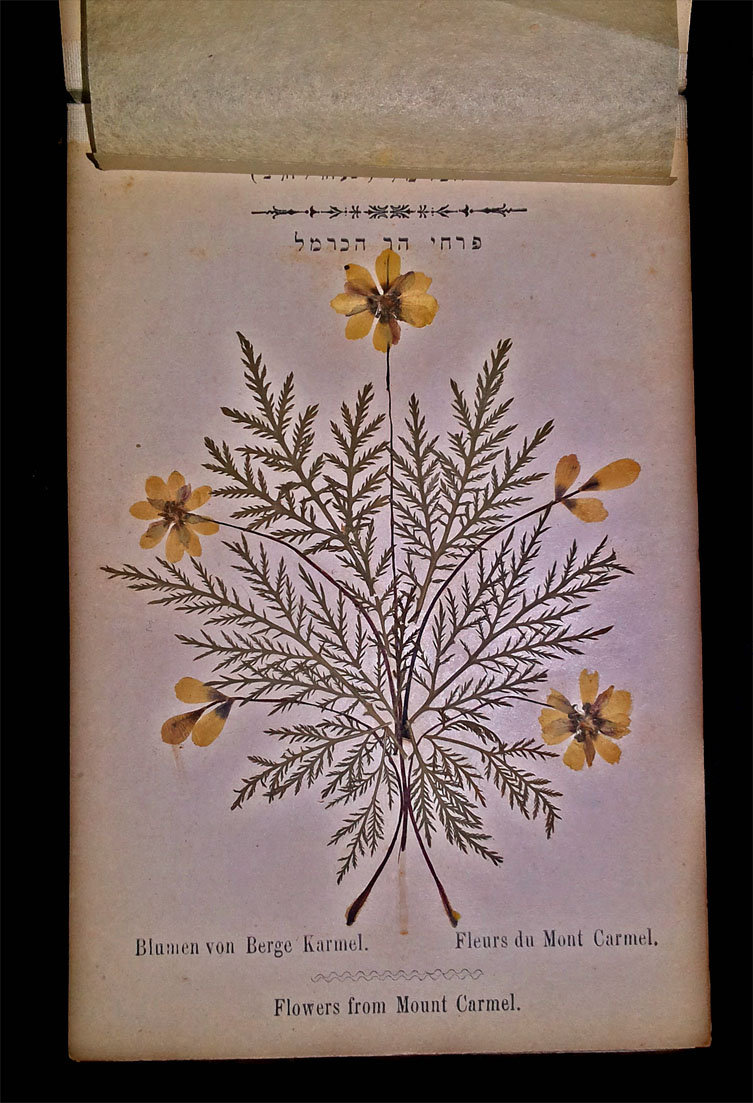
Ancient Manuscript Review 172 : Antique Album of Flowers from Jerusalem c. 1900s


This is a rare antique album of real pressed flowers collected from 12 important places in Jerusalem.
The flowers and leaves are arranged beautifully on captioned card and have been well preserved for more than 100 years.
The album is cloth bound with covers made of thick polished olive wood and spine of leather.
The album is supposed to be open from the right cover where the word Jerusalem in English and Hebrew are painted with multicolored inlay border.
Each plate is captioned in Hebrew, English, German and French.
The titles of the plates are :
1)Flowers from Jerusalem
2) Flowers from Mount Sion
3) Flowers from Mount Moriah
4) Flowers from Siloah
5) Flowers from the grave of Rachel
6) Flowers from Hebron
7) Flowers from  the Mount of Olives
8) Flowers from the Valley of the Jordan
9) Floweres from Mount Carmel
10) Flowers from Saron,
11) Flowers from the Mount of Gerizim
12) Flowers from the Mount Hermon.

Album measures 4 1/4 x 6 1/2 inches and is in excellent condition with only light surface wear and a few pieces of the mosaic missing from the corner areas.


Friday, December 11, 2015

Ancient Manuscript Review 171 : Antique Kufic Quran on Vellum / Parchment ( 10th Century)


This is a vellum with both sides written Quranic verses in Kufic script. Acquired from an acquaintance in Paris. The vellum originally belonged to a Professor of Islamic Art. I couldn't verify the exact date of this vellum however based on the script (Kufic), I would estimate it around 9th -10th century CE based on the type of calligraphy. The leaf was in 3 fragments.

Codicology
Title Page : Nil
Content    : Quranic Verses
Date         : 9th-10th Century CE
Copyist    : Anonymous
Patron      : Nil
Origin      : Near East or North Africa
Place acquired : Paris
Illuminations : Nil
Calligraphy :Kufi
Number of lines :6 lines per page
Inks          : Main text in red
Punctuation: Diacritical marks in red.
Frame       :  Nil
History of Manuscript : Originally belonged to a Professor of Islamic Art in Paris. His family sold some of these vellums to a friend. I acquired this vellum from him in 2013.
Number of folios : 1 f
Support of writing : light redish vellum
Gatherings : N/A
Catchwords :Nil
Dimensions : 22.0 cm x 18.0 cm
Binding   : Nil
Estimated Market Price :
Purchased Price : USD
Remarks : 

Sunday, December 6, 2015

Ancient Artifact Review 59 : Antique Malay Gold Threaded Pillow Ends / Tekat / Tampok Bantal ( early 20th Century)


These are 2 Malay artworks called tekat. It is a gold thread embroidery practiced by the Malay from Malaysia.  These beautiful pieces are sewn onto both ends of a bolster ( bantal peluk) as part of  the bridal decorations which is typical in Malay weddings. Traditionally, to have the entire bridal daise and chamber decoration done in tekat is almost a must. These days, one doesn't have to worry about creating a tekat arrangement for the wedding. In Malay wedding, its customary to use the service of "Mak Andam" or a wedding planner. They have almost complete bridal decorations arrangement and lend them out for a very reasonable price.
Tekat originally was a court art and gained popularity by the 15th Century. It was thought that this art originated from Ottoman Empire and brought into the royal court of the Malay Kingdom by the traders.
In this sample, the gold thread was stitched in a patterned way over a piece of of a maroon velvet fabric. Motifs of foliage and floral were used as Islam prohibits using animal motifs. I believed these samples from early 20th Century CE.
As we can see from my other entries , some bolsters' ends are sewn with decorated metal plates. Below are the links to the plates :

Malay Plate 01
Malay Plate 02

Compare this plate with Peranakan plates in below link
Peranakan Tampok Bantal

Specification :
Description : Malay bolster Tekat
OD : 4 inches
Material : Gold Thread on maroon velvet fabric
Ref :  Islamic Civilization In The Malay World (pg 325)

Thursday, December 3, 2015

Ancient Artifact Review 58 : Antique Etiopia Priest Leather Bible Carrying Case / bag ( 18th Century)


This is an old leather bag used to carry an Etiopian Psalter. This typical bag normally made for the priests. Dimension of 220mm x 140mm made of goat leather and sides were sewn with leather strings. It comes with closing flaps at the top and leather string attached on both sides.


Item Spec :

Item : Antique Etiopia  Bible Carrying Case
Description : A leather bag made of goat skin.
Dim : 220mm x 140mm
Date : 18th century CE
Origin : Etiopia
Purchased Price :US

Tuesday, November 24, 2015

Ancient Coin Review 89 : Sultanah Taj Alam ( Aceh Sultanate 1641-1675 CE)


This is a gold coin from Sultanah Taj Alam Safiat AdDin Shah era. She is the first female to be throned in Aceh Sultanate. She was a widow of Sultan Iskandar Thani. She reigned Aceh from 1641 - 1675 CE.

Looking at the Arabic calligraphy used, its quite tricky as the calligraphy is compressed to fit on the coin face. However it has the resemblance to Thuluth & Sini. Or probably this is how Malay calligraphy was derived.
Obverse : فادك سر يلطانه تاج العالم     
                 Paduka Sri Sultanah Taj Al Alam
Reverse : صفية الدين بردولة شاه
                Safiat Aldin Berdaulat Shah


Aceh is a state located at the northern end of Sumatra island ( Indonesia). It is also known by its Arabic honorific Darus Salam ( Abode of Peace) from 1511-1959 CE.
Aceh's origins are unquestionably Cham, as the Champa king Syah Pau Kubah sent his son Syah Pau Ling to rule over Aceh when the capital Vijaya in 1471 AD, was sacked by the Vietnamese Le Dynasty.
The Sultanate of Aceh was founded in 1511 CE after the fall of Pasai Sultanate by Sultan Ali Mughayat Shah. It’s presumed that he is the same person as Syah Pau Ling who converted to Islam.
The Sultanate lasted till 1903 when the last Aceh Sultan Muhammad III Daud Shah Johan Berdaulat surrendered to Dutch occupation.

Look my other variation of this coin in below link :
Taj Alam 9


Obv:   فادك سر يلطانه تاج العالم    Paduka Sri Sultanah Taj Alam
Rev:   صفية الدين بردولة شاه   Safiat Ad Din Berdaulat Shah
Weight : 0.61 gm
Dim : 1641 - 1675 CE
Rarity :
Denom : Mas
Material : Gold
Reference : A 17a type 1 pg 177 ( Jaarboek Voor Munt-en Penningkunde)

Ancient Coin Review 88 : Sultanah Kamalat Shah ( Aceh Sultanate 1688-1699 CE)


This is a gold coin from Sultanah Kamalat Shah era. She is the fourth female to be throned in Aceh She reigned Aceh from 1688 - 1699 CE.
After protests from people who wanted a male sultan, especially after a fatwa from a Kadi in Mecca  stating that a woman as a head of state is in conflict with the laws of Islam, she was desposed in October 1699.
Looking at the Arabic calligraphy used, its quite tricky as the calligraphy is compressed to fit on the coin face. However it has the resemblance to Thuluth & Sini. Or probably this is how Malay calligraphy was derived.
Obverse : فادك سر يلطانه كمالة شاه
                Paduka Sri Sultanah Kamalat Shah
Reverse : زينة الدين بردولة شاه

                Zainat Aldin Berdaulat Shah


Aceh is a state located at the northern end of Sumatra island ( Indonesia). It is also known by its Arabic honorific Darus Salam ( Abode of Peace) from 1511-1959 CE.
Aceh's origins are unquestionably Cham, as the Champa king Syah Pau Kubah sent his son Syah Pau Ling to rule over Aceh when the capital Vijaya in 1471 AD, was sacked by the Vietnamese Le Dynasty.
The Sultanate of Aceh was founded in 1511 CE after the fall of Pasai Sultanate by Sultan Ali Mughayat Shah. It’s presumed that he is the same person as Syah Pau Ling who converted to Islam.
The Sultanate lasted till 1903 when the last Aceh Sultan Muhammad III Daud Shah Johan Berdaulat surrendered to Dutch occupation.


Look my other variation of this coin in below link :
Kamalat Coin Unlisted

Obv: فادك سر يلطانه كمالة شاه  Paduka Sri Sultanah Kamalat Shah
Rev: زينة الدين بردولة شاه  Zakiat Ad Din Berdaulat Shah
Weight : 0.61 gm
Dim : 14mm
Date : 1688 - 1699 CE
Rarity :
Denom : Mas
Material : Gold
Reference : A 20 type B pg 179 ( Jaarboek Voor Munt-en Penningkunde)

Sunday, November 22, 2015

Ancient Manuscript Review 170 : Antique Kufi Quran Patron Page Saadi Dynasty ( 16th-17th Century )


This is an illuminated page found in one of my Maghribi Quran from Saadi era. It is beautifully colored with natural dye and I believe the patron name is written in Kufi in the middle.
 It reads محمد بركة  ( Muhammad Barkat).


Dim : 200mm x 180mm
Date : 16th Century CE (Saadi Dynasty)
Material : Western Paper
Origin : Morocco

Saturday, November 21, 2015

Ancient Artifact Review 57 : Antique Qajar Persian Qalamdan Lacquered Box 18th century

This is an old Persian Paper Mache box which measures 210mm x 64mmx 45mm originating from Qajar. This box could probably serve as pen case or Qalamdan.
It is beautifully lacquered in a floral motif with beautiful bright colors.
The box painted in polychrome and gilt,  covers and sides with bulbuls perched amidst wild roses and apple blossoms.


See my other Lacquered boxes on below links
Qajar Qalamdan
Persian Qalamdan

Dim : 210mm x 64mm x 45mm
Date : 18th Century CE ( Qajar Persia)
Material : papier-maché
Origin : Afghanistan

Thursday, November 19, 2015

Book Review 14 : The Significance of Islamic Manuscripts - Al Furqan Islamic Heritage Foundation


Book Info :

Title : The Significance of Islamic Manuscripts
Author : Various authors
Publisher : Al Furqan Islamic Heritage Foundation
Printer :
Pages : 180 pages
ISBN :1-873992-05-X


Review :

This is an excellent book published proceeding from the Inaugural Conference of Al Furqan Islamic Heritage Foundation held in London from 30th November -1st December 1991.
Its collections of 12 papers presented by eminent scholars from all over the world in regards to Islamic manuscripts.
Below are the title of the papers :
1)  Manuscripts in Historical Research and Text Edition
     by Wilfred F. Madelung
2)  The Significance of Islamic Manuscripts
     by Seyyed Hossein Nasr
3)  Persian Manuscripts with Special Reference to Iran
     by Iraj Afshar
4)  Collections of Islamic Manuscripts in the Former Soviet Union & their Cataloging
     by Anas Baqi Khalidov
5)  Islamic Manuscripts in the West
     by Angelo Michele Piemontese
6)  Turkish Manuscripts and the Publication of their Catalogues
     by Ramazan Sesen
7)  Classification of Andalusian & Maghribi Books of Nawazil from mid 5th to end 9th Century AH
     by Muhammad Al Habib Al Hilah
8)  A Study on the Manuscript Translations of the Holy Quran
     by Ekmeleddin Ihsanoglu
9)  Manuscripts in the History of Makkah and Madinah
     by Hamad Al Jasir
10)Some Remarks on Islamic Scientific Manuscripts & Instruments, Past Present & Future Research
     by David A King
11)Islamic Philosophical Manuscripts
     by Mehdi Mohaghghegh
12)Rare Literary Manuscripts in the Library of Abd Al Qadir Al Baghdadi
     by Abdul Aziz Ahmed AL Rifai

I bought this book during my visit to Islamic Arts Museum In Kuala Lumpur few years ago.